

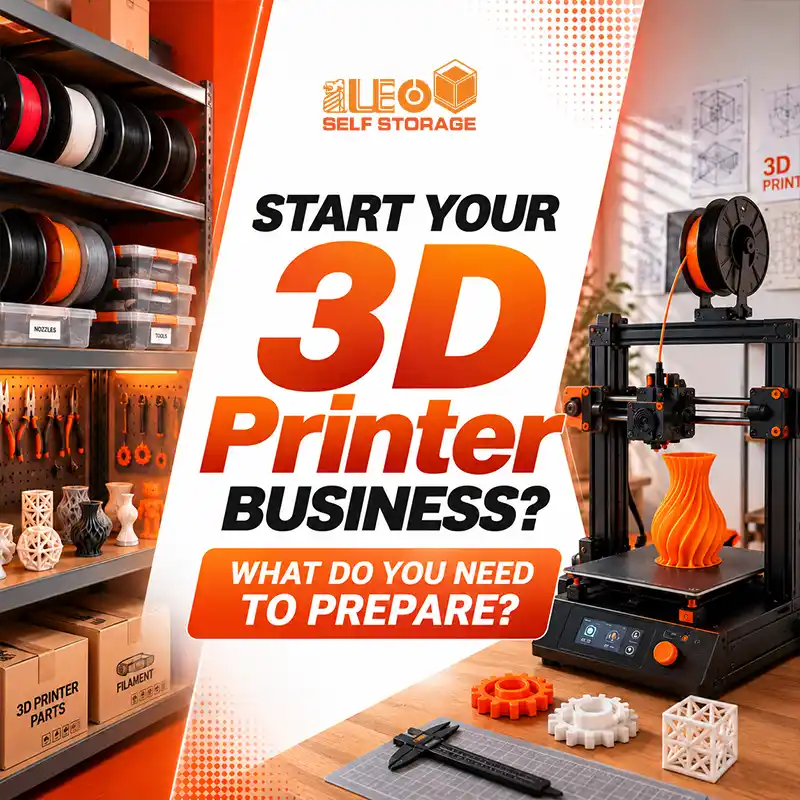
Key Things to Know Before Starting a 3D Printing Business
- Starting a 3D printing business requires more than just a 3D printer. You also need suitable printing materials, design skills, a dedicated workspace, and a clear sales strategy. It is best to start with products that meet the needs of a specific target market before gradually expanding your business.
- As the number of printers, raw materials, and finished products increases, space management becomes an important business consideration. Entrepreneurs can rent a self-storage unit or additional storage space to keep inventory separate from their homes or offices.
- A 3D printing business can start small and gradually increase its production capacity, making it suitable for both individuals looking to earn extra income and entrepreneurs planning to build a full-time business.
What Is a 3D Printing Business, and Why Is It Worth Considering?
3D printing, also known as additive manufacturing, is the process of creating physical objects from digital designs. A 3D printer builds an object layer by layer until the final product matches the intended design.
One of the key advantages of 3D printing is its ability to produce customized products, unique shapes, and small production batches without the need for expensive molds commonly used in traditional manufacturing.
This technology creates a wide range of business opportunities, from home decorations, models, figurines, collectibles, and organizational accessories to personalized gifts, specialized replacement parts, and prototypes for other businesses.
However, before getting started, it is important to answer two fundamental questions: “What products will you create, and who will you sell them to?”
Your answers will influence your choice of equipment, printing materials, production costs, and overall marketing strategy.
1. Choose the Right 3D Printer for Your Products
The first thing you need is a 3D printer. However, there is no need to invest in the most expensive machine right away. Instead, choose a printer based on the types of products you plan to manufacture.
For example, if you want to produce everyday household items, organizational accessories, or medium-sized objects, an FDM (Fused Deposition Modeling) 3D printer may be a suitable choice.
On the other hand, if your business focuses on detailed models, miniatures, or products that require high precision, a resin 3D printer may be more appropriate.
Beyond the initial purchase price, you should also consider factors such as build volume, printing speed, resolution, replacement parts, maintenance costs, and material availability.
Once your business starts receiving regular orders, printer reliability and production time will directly affect operating costs and customer satisfaction.
2. Develop 3D Design Skills and Prepare Printable Files
Owning a 3D printer alone is not enough to run a successful 3D printing business. One of the most important elements is the digital design file used to create each product.
Entrepreneurs should have a basic understanding of 3D modeling software or be able to modify existing designs to make them suitable for printing.
It is also important to understand slicer settings, including:
- Layer Height: Determines the thickness of each printed layer and affects surface quality and printing time.
- Infill: Controls the internal structure and density of the printed object.
- Support Structures: Provide temporary support for overhanging or complex parts during printing.
- Print Speed: Influences production time and may affect print quality.
If you are not yet able to design your own 3D models, you can start by offering printing services using files provided by customers or designs licensed for commercial use.
However, always check copyright restrictions and commercial licensing terms carefully, especially when working with characters, logos, branded designs, or other intellectual property.
3. Calculate All Costs Before Setting Your Selling Price
One common mistake among new 3D printing entrepreneurs is calculating production costs based only on printing materials, such as filament or resin.
In reality, several additional expenses must be considered, including electricity, printer depreciation, replacement parts, printing time, labor costs for design and post-processing, packaging, shipping, advertising, and failed prints.
Before setting your selling price, calculate the total cost per unit and establish an appropriate profit margin.
This is particularly important for products that require several hours of printing.
Remember that every hour your printer spends producing one item is an hour it cannot be used to manufacture another product. Therefore, production time and machine capacity should also be factored into your pricing strategy.
4. Prepare Suitable Production and Storage Spaces
As your 3D printing business grows, one of the biggest challenges may not be the number of orders but the amount of space required to manage your operations.
In addition to 3D printers, you will need space for storing filament, resin, spare parts, tools, packaging materials, finished products, and items waiting to be shipped.
For entrepreneurs starting a business from home or a condo, adding more printers and maintaining larger inventories can quickly reduce available living space.
This is where renting a self storage unit can become a practical solution.
By moving excess inventory, packaging supplies, and equipment that is not used every day into a separate storage space, you can keep your production area more organized and efficient.
It also allows you to expand your business without immediately committing to the higher costs of renting a large office or warehouse.
However, printing materials such as resin and certain chemicals may require specific storage conditions and safety precautions. Always check the manufacturer’s recommendations and the storage facility’s policies before storing these materials.
5. Establish an Inventory Management System Before Expanding
Although 3D printing allows businesses to manufacture products on demand, growing sales may eventually require keeping popular items in stock.
You may also need to maintain larger quantities of printing materials in different colors and types, along with additional packaging supplies.
Without an effective inventory management system, problems can quickly arise, including misplaced products, duplicate stock purchases, and cluttered workspaces.
Entrepreneurs with limited space can consider renting additional storage as their inventory grows.
For better organization, separate items into categories such as:
- Finished products ready for sale
- Printing materials and raw materials
- Packaging supplies
- Spare parts and backup equipment
A well-organized storage system makes it easier to locate products, monitor inventory levels, and prepare orders efficiently.
6. Plan Your Sales Channels and Build a Unique Brand Identity
As the 3D printing market becomes increasingly competitive, competing on price alone may not be a sustainable long-term strategy.
Instead, focus on creating value and differentiating your brand.
For example, you could offer personalized designs, custom-sized products, collectibles, specialized business accessories, or end-to-end services ranging from prototype design to final production.
You can start selling through social media platforms, online marketplaces, or your own website.
To attract customers, consider sharing photos and videos of your production process, product reviews, and real-life applications of your printed products.
This type of content helps potential customers understand the craftsmanship, functionality, and value of 3D printed products rather than comparing prices alone.
From a Small Home Business to an Organized and Scalable Operation
One of the greatest advantages of starting a 3D printing business is that you can begin with just one printer and gradually expand your production capacity as sales increase.
However, as your business grows, so will the number of printers, raw materials, finished products, and packaging supplies.
Planning your workspace and storage needs early can help prevent space limitations from becoming an obstacle to future growth.
For entrepreneurs who are not yet ready to take on the costs of renting a large warehouse or office, LEO Self Storage offers a flexible storage solution for business inventory, suitable raw materials, packaging supplies, and equipment.
With a variety of storage unit sizes available, you can choose a space that matches your current storage needs and explore additional space as your business expands.
Starting a business does not mean you need a large workspace from day one.
What matters most is making efficient use of the space you already have and preparing your operations for future growth.
With proper planning and organization, you can focus on growing your 3D printing business without letting limited storage space hold you back.
FAQ: Frequently Asked Questions About Starting a 3D Printing Business
Q: Does starting a 3D printing business require a large investment?
A: Not necessarily. You can start with a single 3D printer, basic printing materials, and essential equipment.
It is often better to test the market with a small product range before making a larger investment.
Once you begin receiving consistent orders, you can gradually add more printers and increase production capacity based on actual demand.
Q: What products can you sell with a 3D printing business?
A: A 3D printing business can produce a wide variety of products, including models, collectibles, home decorations, organizational accessories, personalized gifts, specialized replacement parts, and prototypes for other businesses.
The key is to choose a target market with clear demand and develop products or services that differentiate your business from competitors.
Q: Can you run a 3D printing business from home or a condo?
A: Yes, you can start a 3D printing business from home or a condo, provided you have sufficient space and appropriate conditions for the equipment and materials being used.
Proper ventilation, fire safety, and safe handling of printing materials are particularly important, especially when working with resin printers.
You should also check any applicable building regulations or condominium rules.
As your business expands and inventory begins taking up too much living space, renting a self storage unit can help separate stock from your production and residential areas.
Q: When should a 3D printing business consider renting storage space?
A: You should consider renting additional storage space when inventory begins interfering with your workspace or living area, products become difficult to locate, or you need to purchase larger quantities of materials and packaging supplies.
Having a separate storage area can help you organize inventory more efficiently and prepare your business for future growth.
Q: How can self storage benefit a 3D printing business?
A: Self storage can be a practical solution for keeping finished products, packaging supplies, spare equipment, and suitable raw materials that do not need to remain in the production area.
Entrepreneurs can choose a storage unit based on their current inventory volume, helping reduce the need to rent a larger commercial space before it becomes necessary.
For materials that require special temperature control, ventilation, or hazardous-material handling, always confirm that the storage facility permits and can safely accommodate them.
Q: What should you consider when choosing storage space for your business?
A: When selecting a storage facility, consider its location, unit size, ease of loading and unloading, access hours, security systems, and rental terms.
It is also important to choose a storage solution that can accommodate changes in your inventory levels as your business grows.
A conveniently located and well-organized storage facility can help improve daily operations while keeping storage costs manageable.